
By Myrna Castrejón, CCSA President & CEO
We use the word “innovation” a lot in education.
It can mean different things to different people. For some, it describes a new technology or a different way of teaching. For others, it might mean a redesigned classroom or a program that did not exist a few years ago. As I travel across California visiting charter public schools that are as diverse and unique as the state itself, I keep coming back to a fundamental question: What does innovation in education really mean?
To me, doing something new is not enough. It should make learning better. It should expand opportunity. And ultimately, we should be able to look at the evidence and ask whether students—especially those who have historically been underserved by our public education system—are better off because of it.
I recently spoke with Matthew Wunder, CEO and Superintendent of Da Vinci Schools, a network of charter public schools in Los Angeles County that has spent years wrestling with that question.
<< Matthew describes each Da Vinci school as a “lab.”
“Each one of our schools is a lab,” he told me. “We should be trying to figure out how to do better or how to get better outcomes for students.”
I like the laboratory analogy because a good experiment requires us to explore further and dig deeper. We observe what happens. We examine the evidence. We learn. And then we keep improving.
At Da Vinci, that means intentionally building a learning environment that connects school to the real world, especially for high school students.
Students learn through hands-on projects and career pathways in fields ranging from engineering and computer science to architecture, media production and entrepreneurship. They work with industry professionals and gain exposure to careers and mentors. Some students can even begin earning college credits while still in high school.
The goal is not simply to make school more interesting. It is to ensure every student—regardless of their background—has the opportunity to apply what they know, discover their strengths and begin seeing possibilities for themselves beyond high school. 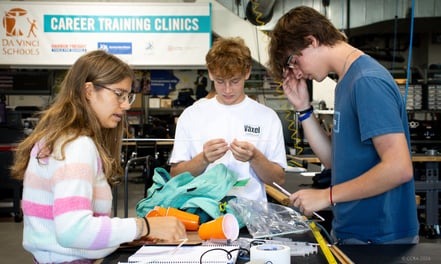
And that is where I believe new approaches must intersect with equity.
When schools intentionally make these experiences part of a student's education, they are not simply creating a different way of learning. They are expanding who gets access to opportunity.
That matters at Da Vinci, which serves a diverse student population that includes large numbers of Latino, Black and socioeconomically disadvantaged students.
Ninety-four percent of Da Vinci graduates complete the courses required for admission to California's public universities. Eighty-two percent enroll in college immediately after high school, and 91 percent persist into their second year of college.
One of the great promises of the charter movement is the flexibility to rethink traditional approaches to public education—and to use that flexibility with purpose: trying promising, data-informed practices, examining their impact, learning from what works and what does not, and bringing effective practices and opportunities to more students and communities.
Across Los Angeles and California, that can look very different. It might mean career-connected learning in one community, a dual-language program in another or a new approach to reaching students who have struggled in traditional settings. 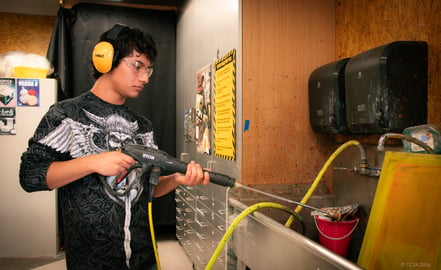
There is no single model for innovation. But perhaps we should expect the same things from it everywhere: purpose, evidence and equity.
Ultimately, families care whether their child is learning. Whether they are challenged and supported.
Whether school is opening doors to college, a career and a future they can imagine for themselves.
As Matthew Wunder told me, “Our job as parents is to set our kids up—and all the kids we serve—for good lives filled with happiness, filled with purpose.”
That should be our test—not simply whether an idea is new, but whether it works, whom it works for and whether its benefits reach students and communities that have too often been denied access to opportunity.
That is innovation worth pursuing.
Myrna Castrejón has been the President and CEO of the California Charter Schools Association since January 2019. Innovate & Educate is an occasional column in which she explores statewide K-12 issues through a charter public school lens.