
At Alma Fuerte Public School in Pasadena, you can feel the energy the moment you walk on campus—kids problem-solving, tinkering, testing ideas, and talking proudly about the things they’ve made. What’s taking shape here isn’t a push to turn children into entrepreneurs; it’s something simpler and more powerful: helping students discover their creativity, confidence, and ability to shape their own future.
That kind of self-directed or guided learning is critical as we enter a new era of artificial intelligence and customization in all professions – especially in business.
Educators at Alma Fuerte say hands-on entrepreneurial learning increases students’ confidence, problem-solving, initiative, and the ability to complete complex tasks. In other words, when kids learn to take an idea from concept to execution, they develop the kind of self-efficacy that carries into every aspect of life.
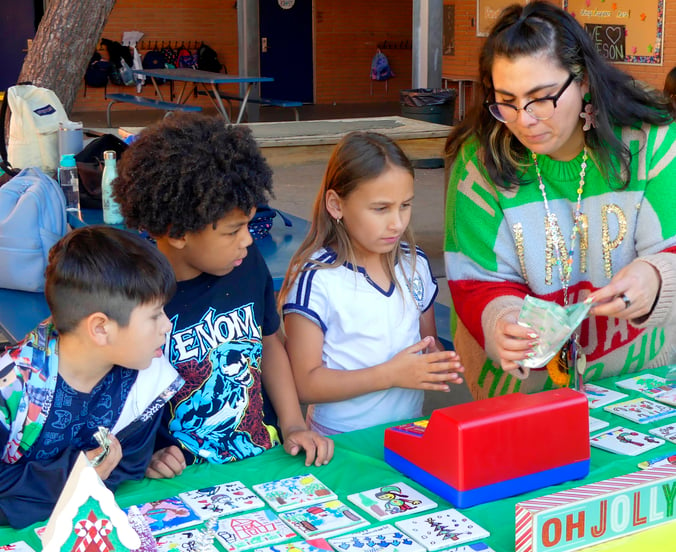
“As we move into the 21st century, technology moves faster than we can predict,” said Community Schools Director Adriani Leon. “It’s not about teaching one specific hard skill, because those skills change. What doesn’t change are the soft skills—teamwork, leadership, resilience, adaptability. If our students can communicate well and pivot when something doesn’t go as planned, they can be successful anywhere.”
Alma Fuerte’s entrepreneurship program evolved organically over its eight years, guided by student interests and community creativity. In the early days, students made homemade soap using leftover condiment containers as molds. They set up a table at a local farmers' market and practiced rotating roles—welcoming customers, managing money, and pitching their product. One parent even called to ask when students would make soap again, since it was so popular at home.
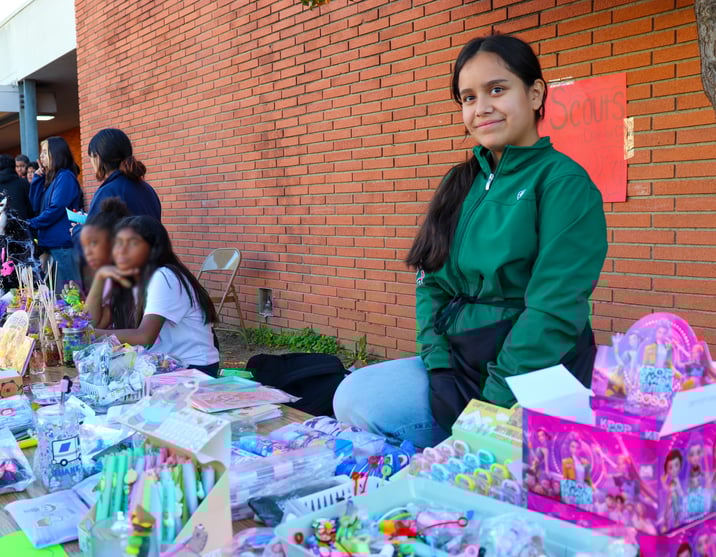
What began as a simple project has grown into a vibrant maker-space culture. Students now have access to sewing machines, soap- and candle-making materials, a 3D printer, and even a Glowforge laser cutter—allowing them to design and sell puzzles, keychains, custom pens, and more. Three times a year, the school hosts business fairs where students showcase their creations and keep their earnings. Many walk away with more than $100 per fair, and some even use that money to buy school supplies, cover household expenses, or help their families. One sixth grader, Ronnie, once earned nearly $200 from a single invention. “I like being creative and helping my friends,” he said. “And the money helps my family a lot.”
Eighth grader Katia has earned more than $180 at each fair, selling handcrafted holiday goodies and customized pens she makes with her mom. “Honestly,” she said with a smile, “I like that I get to keep the money for myself.” But she also uses her earnings to reinvest in her business—purchasing a cash register and materials to keep improving. “With the money, I’ve been able to get more organized.”
Then there is Camila, also in eighth grade, who started a tutoring business this fall. She works with younger TK–5 students twice a week and has earned more than $100 a month. “When I see the kids improve, it makes me happy,” she said. “I remember struggling when English wasn’t my first language. Helping them feels like giving back.”
For Adriani, these stories reflect something more profound: young people discovering that their ideas matter. “These students have literally built the school with us,” she said. “Their interests shape our programs.” From food-based ventures—supported by students earning their official food-handlers cards—to a soon-to-open student-run café, Alma Fuerte is building pathways that teach both job skills and agency.
The school is also cultivating valuable public speaking and presentation skills through its annual Kids Business Fair, a community celebration where students sell products, test ideas, and learn what it means to take pride in their work. It’s a joyful affirmation that children aren’t just absorbing knowledge—they’re creating value, solving problems, and learning who they can become.
Not every student plan to be an entrepreneur—some dream of becoming lawyers, teachers, or artists. But entrepreneurship education gives them something even more powerful than a business plan: a sense of possibility. A belief that if one path closes, they can pivot and find another. A confidence that their ideas have worth.
Charter schools were founded to reimagine what education could be. Alma Fuerte shows what that looks like in practice—students learning to adapt, take initiative, and build their futures one idea at a time.
Myrna Castrejón has been the President and CEO of the California Charter Schools Association since January 2019. Innovate & Educate is an occasional column in which she explores statewide K-12 issues through a charter public school lens.